

Can You Clean Electronics With Rubbing Alcohol
A diverseness of chemicals tin can be institute throughout the electronic associates and repair process, but no solvent appears more than normally than isopropyl alcohol. Information technology is universally used for cleaning and as a main constituent of fluxes, just how much practice you actually know well-nigh isopropyl alcohol?
Isopropyl booze (CAS #67-63-0) is as well referred to every bit IPA, isopropanol, 2-propanol, and even rubbing alcohol (more on that later). It dissolves a broad range of both polar and nonpolar soils, and is oftentimes used to deliquesce and remove light oils, fingerprints, cutting fluids, flux residues, carbon deposits, and mold release. It is also readily miscible in water, which makes it an effective drying agent.
For electronic printed circuit board (PCB) associates, you volition find isopropyl booze beingness used either to make clean flux residues from recently soldered excursion boards, or in PCB repair and rework. IPA is also used to remove solder paste or adhesive from SMT stencils. Maintenance cleaning with isopropyl alcohol is mutual for removing caked-on and burnt-on flux from SMT reflow ovens, moving ridge soldering fingers, selective soldering nozzles, pallets, and anywhere else flux tends to collect in automated soldering processes.
Material compatibility of Isopropyl Alcohol
Isopropyl alcohol is by and large uniform with nearly materials used in electronics. Every bit with any chemic production used, component compatibility must exist determined on a non-critical area prior to apply. The following are a list of common materials used in PCB associates and their respective compatibility ratings:
| Material | Compatibility |
|---|---|
| Aluminum | Fantabulous |
| Buna-N | Good |
| CPVC | Excellent |
| Epoxy | Excellent |
| Neoprene | Practiced |
| Noryl | Excellent |
| Phenolic | Splendid |
| Cantankerous-Linked PE | Expert |
| Polycarbonate | Poor |
| Polypropylene | Good |
| Polystyrene | Poor |
| PVC | Fair |
| Teflon | Excellent |
| Tygon | Good |
| Viton | Excellent |
When a solvent is not uniform with a substrate, it may cause crazing (micro-cracks) or soften the material. In the case of seals or gaskets, this incompatibility volition crusade parts to slap-up, shrink, or go brittle. This video shows an farthermost example of acetone on polycarbonate, which causes it to fog, soften, and even scratch from contact with the plastic dropper.
Grades or Types of Isopropyl Alcohol
Isopropyl alcohol is available in a large number of varieties and grades, which are generally differentiated by the amount of water in the solution and trace amounts of other chemicals or nonvolatile materials.
Isopropyl alcohol is hydrophilic, so information technology readily accepts water into an azeotropic solution. When you come across on the label "70% isopropyl booze", it refers to amount of alcohol in relation to the amount of dissolved water – i.east. 70% alcohol to xxx% water. H2o tin be removed to course purer grades of isopropyl booze, resulting in what is chosen "anhydrous" isopropyl booze.
Whether an IPA has 0.2% or 50% water has lilliputian effect on the look and odour of the material, only greatly impacts surface tension (its ability to wet) and the dry time. The more than water isopropyl alcohol contains, the greater the surface tension. This causes the solvent to bead upwardly more equally it dries rather than wet or canvass, which can lead to spotting. "Water spots" are particularly problematic when cleaning mirrors, lenses, and other optics.
The dry fourth dimension is greatly increased as the percentage of h2o in the alcohol solution is increased. This can be an advantage or disadvantage depending on the application. For example, isopropyl alcohol is often used equally a flux remover to remove flux residues from around solder joints. Technicians tend to prefer a fast dry time so that they can clean the electronics and bring them back into service as speedily as possible. When breaking down and removing thick, glutinous, or broiled-on materials, more dwell or soak time is required. Slowing downward the dry time oft improves the cleaning effectiveness. That is i of the reasons seventy% pure isopropyl alcohol is unremarkably used for degreasing and SMT stencil cleaning. In the case of electrical contact cleaning, the faster evaporation time helps ensure that the flammable solvent is gone before energizing the equipment.
This video shows the comparative evaporation charge per unit of fifty% pure IPA, 99.eight% pure IPA, and 100% pure acetone.
The following are typical class designations of isopropyl alcohol, their corresponding specifications, and their operating procedures:
- ACS / reagent grade - meets or exceeds purity standards fix by the American Chemic Order (ACS). This course is specified for food, drug, or medicinal use and other applications that require strict quality specifications and purity over 95%.
- USP grade - meets or exceeds requirements of the United States Pharmacopeia (USP). For nutrient, drug, or medicinal use in addition to nearly laboratory purposes.
- NF form - meets or exceeds requirements of the National Formulary (NF). USP and NF have combined, so USP is generally the entity which is referenced.
- Laboratory grade - near pop grade for use in educational applications, but exact amount of impurities are unknown.
- Purified grade - also called "pure" or "practical form", this meets no official standard and not pure enough for food, drug, or medicinal use.
- Technical grade - is used for commercial and industrial purposes but is not pure enough to be utilized in food, drug, or medicinal utilize of any kind.
The general term "rubbing alcohol" is frequently used for isopropyl alcohol, but users looking to buy a specific class of alcohol should avoid products labeled that style. Rubbing booze does not refer to a specific grade, and may even be a different blazon of booze, similar ethanol (also chosen ethyl alcohol, CAS #67-17-5). Consumer rubbing alcohol can also incorporate other ingredients like denaturant, fragrances, and colorants that are potential contaminants. ASTM D770 (currently on revision 11(2019)) is the standard specification for isopropyl booze published past ASTM International.
Application Methods of Cleaning with Isopropyl Alcohol
As mentioned in a higher place, isopropyl booze is besides bachelor in different grades, or percentages of solvent to h2o, to fit a variety of specific applications. When deciding on the all-time isopropyl production for a particular manufacturing or repair process, first decide on the grade of solvent, then the packaging.
Isopropyl alcohol is easily dispensed in a variety of packaging types to fit requirements for various applications:
- Bulk containers - Isopropyl alcohol is packaged in one gallon bottles, five-gallon containers, 54-gallon drums, and fifty-fifty totes for automatic dispensing. In most cases, a spigot can be attached to the 1 and 5 gallon containers for convenient dispensing in benchtop or workstation use. When transferring to another container, make sure the smaller canteen is properly marked with the chemical name and alert information.
- Pocket-sized bottles / spray bottles - To avoid the risk and hassle of pouring and labelling smaller containers, isopropyl alcohol is too bachelor in smaller plastic containers like pints and quarts. Some accept a trigger spray attachment for convenient cleaning.
- Pump dispensers / dauber bottles - Empty bottles are available to make dispensing even more convenient. A wipe or swab can be saturated in the opening, which is filled with a valve when the user pushes down. This keeps the isopropyl alcohol sealed, which avoids cross contagion when a wipe is resaturated after use, causing it to draw in moisture from the ambient air. These bottles tin come with a variety of features including ESD-safe materials and a selection of labels for standard chemicals like IPA.
- Droplets cans - An aerosol can is a sealed container, so it has some of the advantages of a pump dispenser. In add-on, the propellant forces the solvent out of the tin can, creating agitation as it hits the substrate.
- Presaturated wipes - For the platonic mix of class and part, wipes are available, and are already saturated with isopropyl booze. They tin can come in popular-up tubs where the wipes are pulled upward from the top, plastic boxes or pouches that reduce linting acquired past wipe perforations, and even individually wrapped packages. The individually wrapped wipes are perfect for field maintenance because they fit neatly in a tool box.
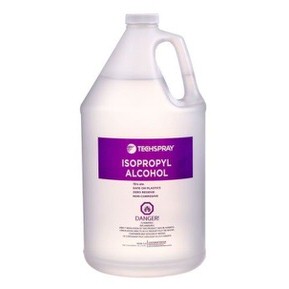
1 gallon
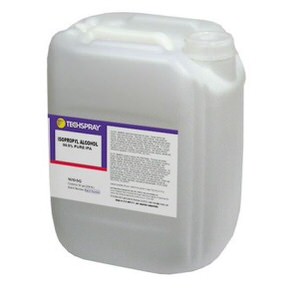
five gallon
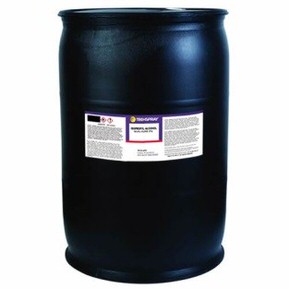
54 gallon pulsate
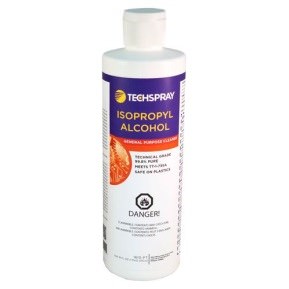
ane pint
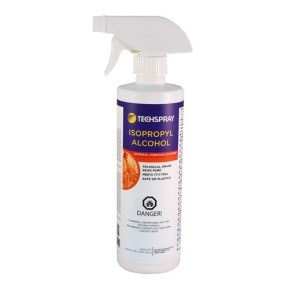
ane pint with trigger sprayer
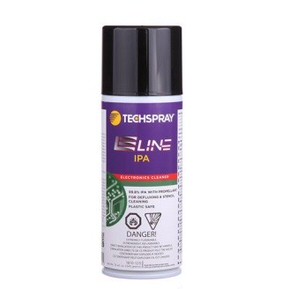
10 oz aerosol tin
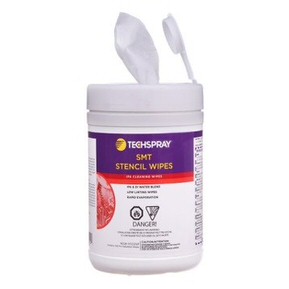
Alcohol wipes in pop-upwardly tub
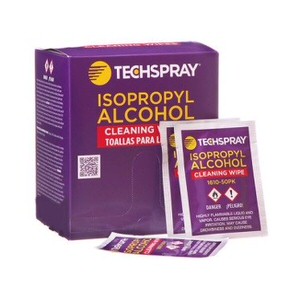
Individually wrapped booze wipes
Safely Handling Isopropyl Booze
Although isopropyl booze is generally considered rubber if handled properly, information technology is a combustible solvent, and then precautions need to be taken to prevent a dangerous situation from developing.
- Ventilation - the work area must be adequately ventilated to forbid an accumulation of vapors, which could combust. Ventilation should exist explosion-proof.
- Storage - considering isopropyl alcohol is very flammable, it needs to be stored in a closed container in a cool, well-ventilated area away from ignition sources like rut, sparks and flames. It has an NFPA rating of 3, so information technology should be stored in a cabinet or room designed for that blazon of chancy fabric. If solvent is transferred to another container, make sure it is marked with the chemical name and required alert information.
- Personal protection equipment - isopropyl alcohol has a tendency to defatten the skin, which ways it draws out the protective oils from the peel and tin can lead to dermatitis if improperly handled. Gloves fabricated of nitrile or other solvent-resistant materials should be worn. Glasses or fifty-fifty a face shield should be worn if the user is spraying an IPA product, or if splashing could occur. Respirators can be used if ventilation is non acceptable enough to avoid breathing in a high concentration of vapors.
- Disposal - isopropyl booze needs to exist disposed of as a hazardous liquid according to country and local requirements. It certainly cannot be flushed downward the drain, and additional disposal requirements may demand to exist followed depending on the soils dissolved in the waste material.
- Safety Data Sheets (SDS) - The cardinal resource for all safety requirements is the SDS, which should be readily available wherever isopropyl alcohol is used.
Conclusion
Is information technology any wonder isopropyl alcohol can be found in all corners of electronic PCB associates, rework and repair operations? It is effective, reasonably priced, and safe if handled properly. To buy isopropyl booze in the form and packaging that is best for your application, go to www.techspray.com.

Source: https://www.techspray.com/cleaning-electronics-with-isopropyl-alcohol
Posted by: harttarin1970.blogspot.com
0 Response to "Can You Clean Electronics With Rubbing Alcohol"
Post a Comment